
Modular Construction Expedites Emergency Care to New Communities

A nationwide partnership is enabling the growth that health systems, including UHS, need to respond to communities' emergency medical needs.
Free-Standing Emergency Departments (FSEDs) are, by definition, a community’s link to healthcare when residents need it most. So, as residential development pushes into new areas across the country, health systems face a pressing need to build – and build quickly.
[elementor-template id="10170"]
Universal Health Services (UHS), a Fortune 500 company that offers hospital and healthcare services throughout the United States, has partnered with Haskell and BLOX to leverage the nascent project delivery method called design, manufacture, construct (DMC) to meet its need for speed to market.
“When you’ve got what a year ago was just flat farmland that now has 3,000 homes on it, those people need healthcare,” said Riley Yeaman, the Haskell Senior Project Manager on the FSED program. “It’s just like a fire department. When you have so much new housing and an exploding community, they have to be able to provide those essential services quickly. So, if you can build as FSED in six months rather than in a year, that's six months of emergent healthcare that people wouldn’t have had.”
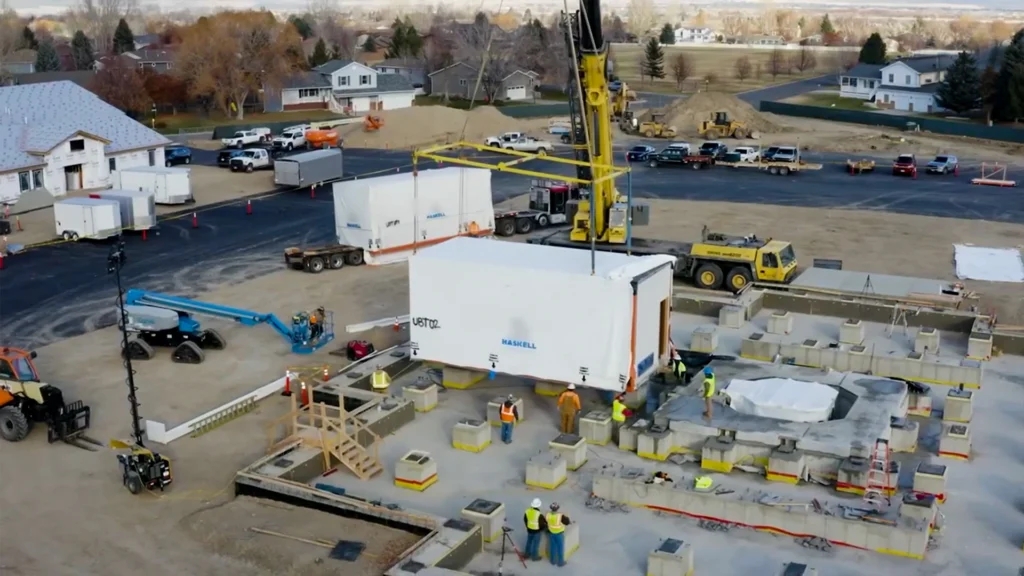
DMC delivery maximizes efficiency by creating replicable modular building components in a controlled manufacturing setting, then shipping them intact to a job site where they are assembled, or “stitched,” before the facility is finished as would be a traditionally constructed building. Onsite, a reduced crew size and shorter schedule produce numerous benefits, including added safety, efficiency, and improved sustainability.
Currently, UHS has four Haskell/BLOX facilities built or in operation, with three underway and several more planned.
Haskell in 2019 made a strategic investment in BLOX, a Bessemer, Alabama-based company that has homed in on the healthcare market and produces large and intricate modules that become the clinic’s operating rooms, emergency rooms and more. As the arrangement has evolved, Haskell has taken on the role of general contractor in the UHS program, bringing to bear its expertise as an integrated design pioneer to streamline the onsite work.
“These facilities are extremely complicated,” Yeaman said. “Every single room in there has a headwall with oxygen and all the different life-safety systems. The med-gas system is an example. It’s tested at the plant, but then you bring it in and you've got to stitch it to complete the system, then you've got to test it all again – and that's the test that matters. So, we’ve been evolving the program to build nationwide program partners.
“We're getting faster at it, and we continue to develop program partners. That's very important. With the uniqueness of modular construction, you've got to have familiarity and expertise specific to that construction model out in the field.”
QuestCom is one such partner. Haskell has a long affiliation with QuestCom, an engineering and contracting firm specializing in telecommunications and other low-voltage systems, and now that relationship has extended to the healthcare DMC space.
“Communications is a huge piece of the puzzle,” Yeaman said. “The communications piece means working out the intricacies around certified ports and servers, patient monitoring, nurse-call systems and security systems. Having a program partner like QuestCom means they develop lessons learned. It allows them to do things better and faster and at a higher quality.
“They're doing the communications and the electrical on every one of these projects. That shaved days and weeks off the schedule. And it further proves ROI (return on investment) to not only UHS, but for Haskell as we build the program.”
Modular construction is most often used for simpler projects, such as the retail or hospitality space, while the complicated nature of healthcare construction has limited the number of entrants in the field – such that the synergy of BLOX’s design and manufacturing acumen and Haskell’s extensive construction expertise have created an industry-leading program.
In addition to UHS, the two have created DMC facilities for HCA Healthcare and Walmart Health.
“We're leading the way, and I have to give a lot of that credit to BLOX,” Yeaman said. “I'm immersed in this on a day-to-day basis, and I don't know that there's anybody even close to what BLOX is delivering to the healthcare industry. And we’ve brought a lot of value as Haskell to the partnership with our construction expertise. I would definitely say that the Haskell/BLOX partnership is leading the way in construction.”
Modularly built medical facilities make differences in people’s lives, safety health and wellbeing. Contact Healthcare Division Leader Mark Allnutt to discuss how to expedite your next facility project.
Related News & Insights

TechWeek Message: Early Integration is Key to Outcomes and Quality
Explore how data centers and modular projects each demand the same discipline: resolve critical details early and carry quality through every phase.
How Programmatic Construction Compounds Improvements, Savings
Standardization creates consistency, but repeated collaboration unlocks greater value. Learn how program optimization differs from project optimization.
Healthcare Designer Helps Launch Jacksonville’s The SPOT
Explore Kristen Argalass's work making The SPOT an accessible place for connection and mental health support through a community-based model.

Is Modular Construction Right for Your Project?
Learn how to determine if modular construction fits your project and brings value. Discover the dos and don’ts of applying this growing delivery method.