

Earthwork Balancing with AI: Haskell Civil Engineers’ Success Story

Artificial intelligence in Autodesk's Civil 3D helped meet the challenge of balancing earthwork while providing the most cost-effective floor elevation.
In the evolving world of civil engineering, innovation is the driving force behind progress. Haskell Civil Engineers recently leveraged cutting-edge technology to streamline their work on a large 65-acre site.
To maximize efficiency, they took an innovative approach powered by grading optimization and artificial intelligence (AI) embedded in Civil 3D by Autodesk. This new technology has transformed the way earthwork is balanced by engineers and allows finished floor elevations to be set much sooner than more traditional means of manual calculation.
– Kevin Crump, P.E., Chief Civil Engineer
Balancing earthwork on a site of this magnitude is a complex and time-consuming task. Traditionally, engineers would rely on manual calculations, multiple grading plan iterations and a substantial amount of time to ensure that the site’s earthwork was evenly distributed, cut to fill. It was a process prone to inefficiencies and costly design change orders late in the project.
The Solution: AI-Powered Grading Optimization
Haskell Civil Engineers took a bold step by embracing the power of AI and the advanced tools offered by Autodesk’s Civil 3D. Grading optimization, coupled with artificial intelligence, became the cornerstone of their strategy. The results were nothing short of spectacular:
- Effortless Earthwork Balancing: Over 260,000 cubic yards of earthwork were balanced with remarkable precision and efficiency, far exceeding what was possible through manual methods. This reduced the margin of error and ensured that the finished floor elevation provided the most cost-effective solution for the customer.
- Finished Floor Elevation Confidence: Setting the finished floor elevation for the new building, a task that often requires extensive time and effort, was completed in a fraction of the usual time. This rapid progress allowed the project team to make more confident data-driven decisions while negotiating costs with the customer.
- Cost Reduction and Environmental Sustainability: Haskell’s innovative approach saved time and resources, reduced costs and minimized the environmental impact. Their commitment to sustainability was exemplified by their ability to cut down on unnecessary earthwork and transportation.
“The grading optimization add-on in Civil 3d has provided us with a tool to obtain a much quicker result in achieving a finished floor elevation early in the design phase,” said John Buehrig, P.E., Civil Project Engineer. It also allows us to reduce costs by minimizing waste and optimizing earthwork volumes. The software runs tens of thousands of grading iterations in a matter of minutes, whereas traditional calculations would take days, even weeks. This is done all with a set of parameters and constraints specified by the engineer, which greatly reduces our time early in the site mass grading process.”
Haskell Civil Engineers’ successful venture into the world of AI-driven grading optimization serves as a true success story and inspiration for the company. It demonstrates the remarkable potential of harnessing technology to solve complex engineering challenges to better service our customers.
This remarkable feat highlights the importance of innovation in the field as engineers continue to seek more efficient, cost-effective and environmentally friendly solutions. By leveraging the power of AI and embracing the tools provided by Autodesk’s Civil 3D, we can expect to see further advancements that push the boundaries of what’s possible in civil engineering.
“Grading optimization in Autodesk Civil 3D is a powerful feature that assists civil engineers, designers and land development professionals in creating more efficient, cost-effective and more environmentally friendly solutions for land development projects,” said Civil Project Associate Arthur Bagourd. “It involves the automatic generation of grading relationships to achieve desired slopes and drainage patterns while minimizing earthwork volumes and construction costs.”
In a world where time is of the essence and cost control and sustainability are top priorities, Haskell Civil Engineers have set a powerful example. Their groundbreaking achievement is a testament to the endless possibilities when human expertise and artificial intelligence join forces, paving the way for a more efficient and sustainable future in architectural and engineering design.
 About the author: Kevin Crump, P.E., is Chief Civil Engineer at Haskell, where he is in his 18th year. He is a LEED-accredited professional with a Bachelor of Science degree in Civil Engineering from the University of Kansas and a Master of Science degree in Civil Engineering from the University of Florida.
At Haskell, we take our clients’ goals as our own. We innovate constantly to ensure that we deliver world-class solutions with the best possible effectiveness, efficiency and performance. Contact us to discuss your facilities needs.
Related News & Insights
RAPTOR Device Advances to Model 2.5, Completing First Field Test
Learn the latest developments from one of the first Big Pitch winners. Discover how Dysruptek is helping advance safer pressure testing.
How ECOncrete is Building a Sustainable Future for Coastal Infrastructure
Learn how a new round of funding is pushing marine construction technology worldwide. Discover sustainable solutions for building materials.

Castano Group’s Big Pitch Production Brings Home an Addy Award
Learn how this frequent Haskell collaborator creates award-winning projects and watch the Big Pitch video that earned.
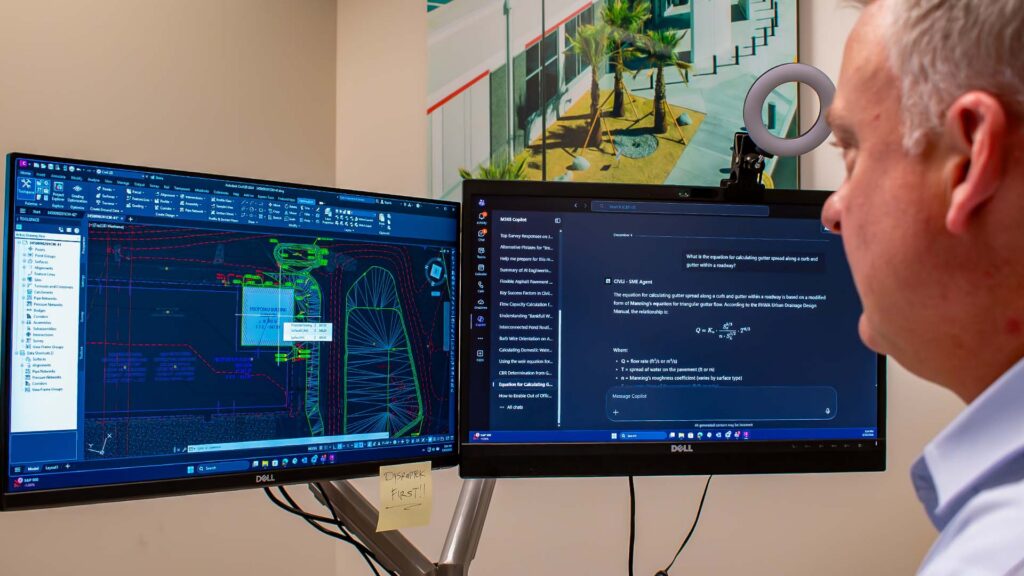
How Will AI Change the Fields of Engineering and Design?
Learn how Haskell’s four-pillar AI strategy strengthens governance, accelerates delivery and empowers engineers and teams enterprise-wide.