

How Automating Power Distribution Can Strengthen Grid Reliability

Municipal utilities and cooperatives use targeted distribution automation to improve grid reliability. Learn to build an effective strategy.
For municipal utilities and electric cooperatives, distribution automation is no longer a distant concept reserved for large systems. Applied selectively, it can help operators see conditions on the distribution grid, respond to faults and use field resources more effectively.
That value does not require a systemwide overhaul. A stronger starting point is a specific reliability or operating challenge: a feeder with recurring outages, a critical load that needs stronger service continuity or a restoration process that keeps crews traveling between sites for routine switching. The central question is not whether automation belongs on the grid, but where automation can produce a clear, measurable benefit.
What Distribution Automation Does
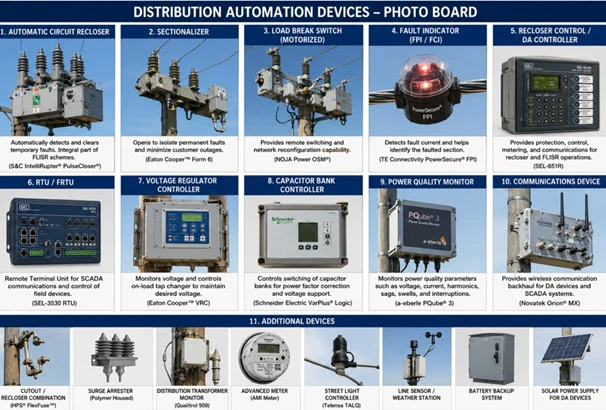
Distribution automation combines intelligent field devices, communications and control applications to monitor and operate portions of an electric distribution system. Equipment may include automated switches, reclosers and sensors connected to supervisory control and data acquisition, outage management or advanced distribution management systems.
In a conventional outage response, operators and crews may need to travel to field devices, locate a fault, isolate the damaged section and restore service manually. When devices and systems are properly configured, automation can detect conditions and support or execute switching and reconnection of unaffected sections while the faulted segment remains isolated. Crews still repair the underlying problem, but operators can gain time and a clearer view of system conditions.
Why Targeted Automation Matters
For municipal utilities and electric cooperatives, outage impacts are often measured in practical terms: how long customers remain without service, how many crews are available, how quickly a fault can be isolated and whether critical loads can be restored first. Targeted distribution automation can improve those outcomes by giving operators better visibility and control on the feeders where faster diagnosis, switching and restoration would make a measurable difference.
Automation is not a substitute for experienced operators and field crews. It is a tool that should make their work more informed and responsive. If a new system creates alarms no one owns, data no one trusts or procedures crews cannot use, the technology adds complexity without improving service.
Start With the Operating Problem
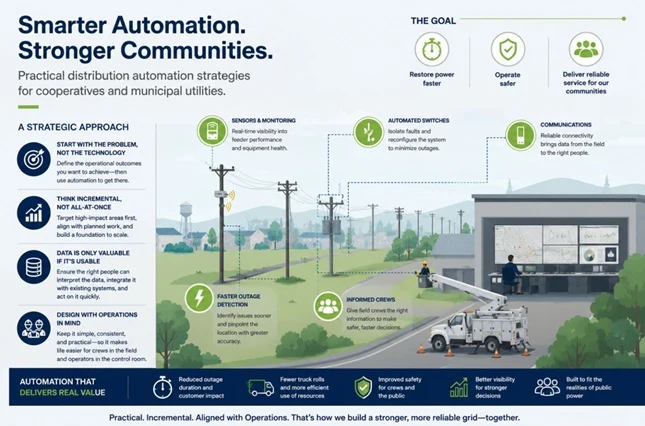
Before selecting devices or software, define the condition the utility needs to change. Are crews spending too much time locating faults? Are certain feeders responsible for a disproportionate share of outage minutes? Does a critical facility depend on a restoration sequence that could be completed more quickly? Is limited visibility slowing an operator’s decision?
The answers establish scope and provide a basis for measuring results. Depending on the objective, useful measures may include outage duration, the number of customers restored before field repairs are complete, switching time, crew travel and patrol time or device and communication availability. Document a baseline before implementation so the utility can determine whether the investment solved the intended problem.
Plan Integration Before Procurement
Field devices deliver value only when the surrounding systems are ready. Planning should account for the accuracy of the distribution model and geographic information system data, communications coverage and performance, protection settings, interfaces with existing control and outage systems, data ownership and maintenance and cybersecurity requirements for access, monitoring and recovery.
That work requires participation from operations, protection and controls engineering, information and operational technology teams, cybersecurity, field crews and asset planning. Together, those groups can define alarm handling, authority to initiate or override automated actions, fallback procedures, testing needs and training before the system becomes part of daily operations.
Build in Deliberate Increments
Utilities can introduce automation as part of planned feeder rebuilds, substation work or improvements serving critical loads instead of treating every deployment as a separate systemwide program. A limited initial deployment also creates an opportunity to test operating modes, verify manual fallback procedures and compare performance with the original baseline before expanding.
An incremental approach still needs an enterprise view. Devices, communication protocols and data structures should fit a defined architecture and roadmap so today’s installation can work with future systems. Without that alignment, a utility may solve one problem while creating another integration barrier.
Make the Data Usable
Automation produces data, but data alone does not improve reliability. Utilities need clear ownership of network models and device records, defined responses to alarms and events and processes that keep information current as field configurations change. Operators and crews also need a shared understanding of what the system is reporting and what action the information should trigger.
Testing should extend beyond the expected sequence. Utilities should understand how the system behaves when communications are lost, data are incomplete, a device is unavailable, equipment is under maintenance or an operator must take manual control. A program can generate large volumes of information and still miss its objective if users cannot trust or act on the results.
Design for People and the Next Decision
Distribution automation works best when it supports the people responsible for the system. Operators and crews need training in what the automation does, when it can act, how to override it and how to recover from an unexpected condition. Their experience should also inform post-deployment adjustments.
The long-term value comes from matching capability to need. Utilities that begin with a defined problem, build on accurate data, plan for integration and security and measure performance can expand automation with greater confidence. In that form, distribution automation is an operating strategy rather than a collection of devices.
Explore Haskell’s Power Delivery Design services to learn how Haskell supports distribution modernization and grid reliability.
About the Author: Edward (Ed) Kobeszka is Director of Business Development on Haskell’s Power Delivery team. An electrical engineer and energy and utilities professional, he brings extensive experience in smart-grid innovation, grid modernization, technical solutions and strategic growth. His work focuses on helping utilities use solutions such as distribution automation to improve reliability, optimize limited resources and meet evolving customer expectations.
Related News & Insights
The Grid Is Aging – and Project Delivery Models Haven’t Kept Pace
Explore how cooperative and municipal utilities must evolve the way projects are planned and delivered to offset increasing demand and uncertainty.
Dependable Energy Storage for Cooperatives and Municipalities
Define the right use cases. Align storage systems with peak shaving and renewable integration to improve reliability and manage costs.
With Contribution from Haskell, Last Energy Completes its Series C
Learn what is next for this young company that is on the forefront of new nuclear deployment and pushing toward a clean-energy future.

Haskell to Push Modular Energy Integration in Wells Fargo Incubator
Learn how Haskell and seven other cohort members will leverage expert support to advance adoption strategies for cutting-edge energy solutions.