
Standardization creates consistency, but repeated collaboration unlocks greater value. Learn how program optimization differs from project optimization.
Over the past six years, we have delivered a highly repetitive building program in which each project contains similar layouts and casework. This consistency created an opportunity to move beyond simply delivering projects and instead establish a continuous improvement process that benefited the owner, designers, suppliers, and construction team.
At the outset of the program, the casework was procured as a traditional turnkey package from a standard supplier. Unlike a conventional stick-built project, the modules arrived with the casework installed, requiring only limited field stitching. During the initial projects, the primary objective was straightforward: prove the concept by delivering a high-quality building that met the owner’s expectations.
Once that objective was achieved, our focus shifted from validation to optimization.
The first phase of improvement centered on constructability. Working alongside the supplier, we refined installation details and reduced the labor required to complete field stitching between modules. As each project was completed, lessons learned were incorporated directly into subsequent designs.
The next phase addressed engineering and coordination. Rather than relying on suppliers, we assumed responsibility for the project-specific shop drawing process through our BIM coordination and Revit models. Suppliers continued to provide manufacturing cut sheets, but the layout, detailing and coordination became standardized within our workflow. This significantly reduced redundant engineering effort while improving coordination across trades.
With repetitive projects providing continuous feedback, optimization extended into manufacturing. Installation experience allowed our team to identify opportunities to simplify field assembly, while suppliers proposed changes to fabrication methods, material utilization and construction details that reduced manufacturing costs without sacrificing quality or performance. Introducing additional suppliers also generated new ideas and competitive innovation, further accelerating improvement.
The results exceeded expectations.
Initially, we anticipated that continuous improvement might reduce costs by approximately 10 to 15% before reaching a plateau. Instead, the iterative process continued to produce measurable gains over multiple years. Through successive refinements in design, detailing, coordination, fabrication and installation, the cost of the casework was reduced by approximately 50% from the original procurement.
Importantly, this outcome was not unique to casework. Similar optimization efforts across other building systems consistently produced cost reductions ranging from 30 to 50%, demonstrating that the approach is broadly applicable across all disciplines when continuous improvement processes are offered to repetitive building programs.
The most significant lesson is that optimization is not a one-time exercise performed during design. It is a process that matures over the life of a program. Early projects establish a successful product and validate performance. Once that foundation exists, owners, designers, suppliers, manufacturers and builders gain the experience necessary to challenge assumptions, refine details, eliminate waste and continuously improve the product.
Rather than reaching a rapid cost plateau, our experience has shown that sustained collaboration across multiple project iterations can unlock significant long-term value. Programmatic delivery creates a feedback loop in which every completed project informs the next, resulting in higher quality, greater constructability, lower cost and improved overall project performance.
One aspect that makes this case study particularly compelling is that it illustrates the difference between project optimization and program optimization. On an individual project, there is rarely enough repetition to justify redesigning fabrication methods or changing engineering workflows. In a long-running program, however, every completed building becomes a source of data, allowing the team to systematically eliminate waste and compound improvements over time. That is a much broader lesson than casework alone and one that applies to industrialized construction as a whole.
Contact our team of experts to discuss your upcoming projects and determine whether programmatic delivery is the right fit for your business needs.
 About the Authors: William Rudder, LEED AP, leads Haskell’s Religious & Cultural market and oversees all pursuits and ongoing projects to ensure the safe and timely delivery of high-quality facilities within budget. He has been with Haskell since 2006 and was instrumental in forming Haskell’s Religious & Cultural market and its Volumetric Modular Construction capabilities.
Related News & Insights
TechWeek Message: Early Integration is Key to Outcomes and Quality
Explore how data centers and modular projects each demand the same discipline: resolve critical details early and carry quality through every phase.
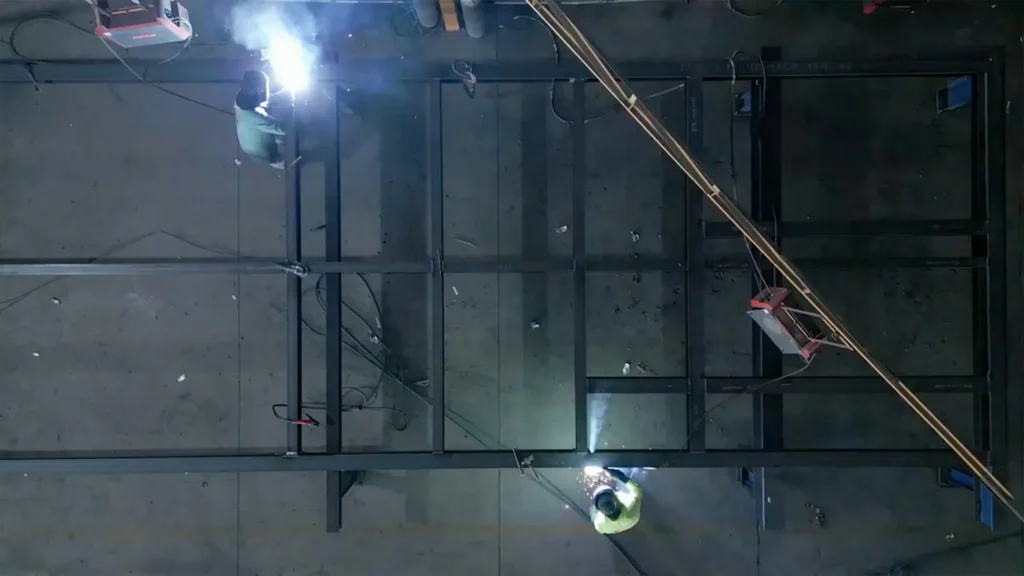
Is Modular Construction Right for Your Project?
Learn how to determine if modular construction fits your project and brings value. Discover the dos and don’ts of applying this growing delivery method.
Why Do Architects Resist Modular Construction?
Understand the structural mismatch behind architects' hesitation toward modular construction. Learn how integrated delivery models are closing the gap.
Discover the Step-by-Step Process of Modular Construction
Learn the inner workings of this fast-growing construction delivery method and how Haskell refines and improves with every project.