

Students Excel Where Design Education, Hands-On Construction Meet

Partnerships with NEFBA and Professional Women in Building immerse students in real projects. See how mentorship accelerates leadership growth.
Teaching skilled trades is not easy. Preparing the next generation of designers, engineers and builders isn’t easy either. For years, these paths have felt oceans apart.
On one side is the driven student who wants to see their designs become reality. On the other is the craft professional with the skill and determination to assemble those ideas piece by piece with their hands. One imagines what could be. The other constructs what must be.
Too often, a line is drawn between the two, and in that space lies one of the greatest challenges in our industry: communication. Building from plans requires coordination and the understanding that even the simplest tasks on paper can feel like moving mountains in real life.
To help close that gap, we have been intentionally developing programs that bring design and construction together from the start. Rather than allowing students to identify with only one side of the “construction coin,” we expose them to both. The results have been promising, and in some cases, truly inspiring.
What we look for first isn’t technical skill. It’s DRIVE.
Drive to create.
Drive to manage.
Drive to build.
Drive to complete.
Drive reveals itself in subtle but powerful ways: going above and beyond, asking thoughtful questions, seeking to understand the problem and most importantly, showing up.
And she did.
Meet Samantha Colina Wuertter.
Through our partnership with NEFBA, their Professional Women in Building (PWB) group and Tocoi Creek High School’s Academy of Innovation in the Build Environment, students are not simply introduced to construction; they are immersed in it. Under the leadership of Chris McKinney, students participate in a program that bridges architectural design and hands-on construction. They design scaled 1,000-square-foot model homes, develop interior layouts and frame conventional wood structures.
Working in teams, they design, build, and manage the construction of these model homes from start to finish. It is not theoretical. It is sawdust, scaled drawings, deadlines, coordination, and collaboration. It is the kind of learning that builds both competence and confidence.
What sets Samantha apart is that she didn’t stop there.
While computer-aided design (CAD) drafting was not required for the project, Samantha chose to draw her projects digitally, pushing herself beyond baseline expectations. That initiative, combined with her continued and active participation in PWB, clearly demonstrates the drive that defines emerging leaders in our industry.
NEFBA’s Professional Women in Building group is more than an organization; it is a leadership catalyst actively shaping the next generation of women in construction. Through mentorship, industry exposure, and hands-on projects, PWB gives young women a direct pathway into the trades, construction management and various related professions.
From constructing full-scale photo backdrops to building raised planter boxes and other functional structures, Samantha and her peers are gaining real-world experience. They are learning project planning, material coordination, craftsmanship and teamwork. They are discovering that construction is not simply an industry; it is a place where leadership is built through action.
Programs like PWB matter because they create visibility and access. They demonstrate that opportunity in construction belongs to those with initiative, work ethic and the willingness to step forward and build.
What stands out most about Samantha is her ability to move between vision and execution. Between imagination and physical construction. She understands that drawings are only the beginning and that true success comes from aligning design intent with field realities.
Watching her growth reignites the possibilities of what construction offers, not only in changing the landscape through what we build, but in shaping the people who build it.
I have no doubt Samantha is going places.
In fact, I can already imagine her walking onto a Haskell project one day as an intern, absorbing the scale, coordination and complexity that define our work. And I can picture the look on her face when she completes her first major project, steps back and realizes that through her contributions, she helped build something significant.
That moment, when drawings become structures and effort becomes legacy, many of us remember that first moment that truly defines us.
The future of construction depends on individuals who understand both sides of the coin, who respect design and craft equally, who communicate across disciplines and who show up with drive.
If Samantha Colina Wuertter is any indication of what’s ahead, that future is bright – and it is being built right now.
About the author: Michael Osborne is a construction professional who advanced from carpenter’s helper to General Superintendent, leading projects across commercial, healthcare, industrial and heavy civil markets. He is now a Craft Development Specialist with Haskell and is part of the team leading the execution of a mobile workforce training program focused on mastering the crafts and elevating field performance. As an NCCER Subject Matter Expert in wood and concrete construction and an OSHA Outreach Trainer, Michael focuses on strengthening craft competency, safety, and production standards across the organization.
Each year, hundreds of Haskell interns from across the architecture, engineering and construction fields gain invaluable hands-on and cultural experience, and 90% of those offered positions join the Haskell team. Contact us to learn more!
Related News & Insights
A Golden Hammer and a Coin-Toss Mark the Start of a Career
Learn how high school carpentry empowered David Hargraves. Discover the history of Haskell Steel’s Production Superintendent.
Visionary Leadership: Crafting Tomorrow’s Government Environments
Discover how Tomra Russell's unique perspective as a Navy spouse and design expert fueled her design success and led to a role as Vice President.
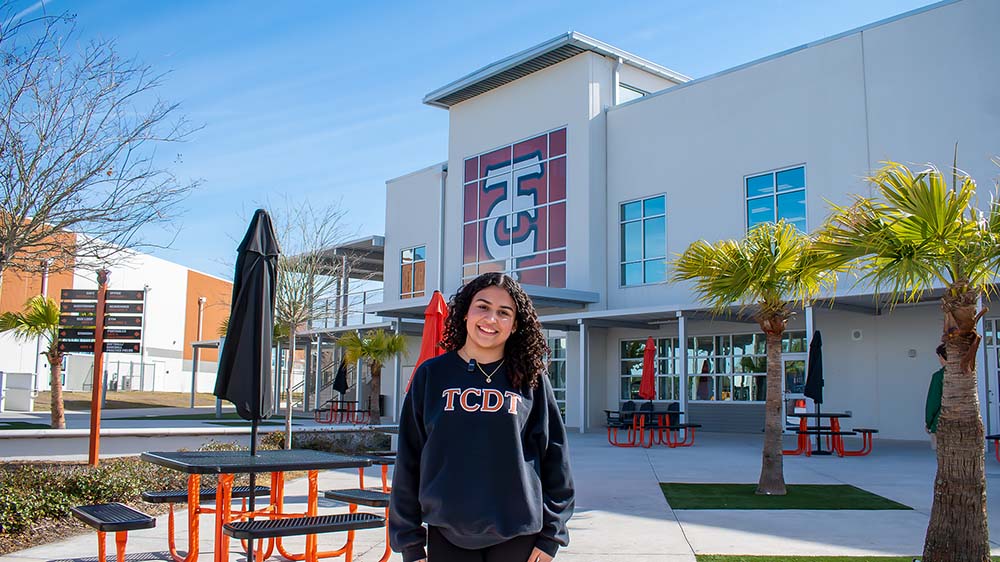
How Student Samantha Wuertter is Design-Building Her Career Path
Learn how Tocoi Creek High School’s Academy of Innovation and NEFBA’s PWB are helping this student turn classroom concepts into jobsite-ready skills.
Architect Janel LeGard Relishes Designing Buildings, Building Careers
Get to know the longtime Haskell team member, who says she was 'born to be an architect' and who shares her talent and inspiration as a mentor.