
Electronic Leak Detection Technology Ensures Absolute Roof Integrity

Learn how Haskell's investment in the cutting-edge ELD system helps detect and repair leaks to deliver the best possible long-term roof performance.
In the construction of large capital projects, the roof is one of the first components installed so interior work can begin. Once installed, though, roofs can be subject to potential damage during the installation of rooftop equipment.
This concern is exacerbated when clients choose single-ply membrane roofs to save costs. Because of their single-layer design, these membranes can be more susceptible to punctures from fasteners, sharp metal, tools, welding activities, etc., than a traditional rubberized asphalt roof system that comprises multiple layers.
Historically, Haskell partnered with third-party testing agencies to electronically locate roof breaches. However, as the scale and scope of projects grew, investing in the necessary technology became more cost-effective. In late 2023, Haskell’s Quality team recently obtained its low-voltage Electronic Leak Detection (ELD) system, the IntegriScan from Detec Systems.
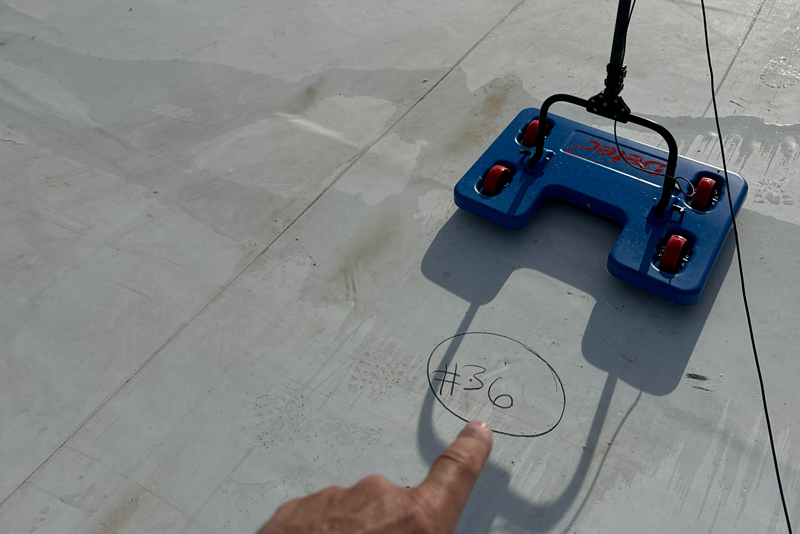
ELD is highly effective because water conducts electricity very well — at least 10 times as well as most roofing membranes. To use the machine, the roof is covered with water, which then pools in any holes in the membrane. As the system passes over the roof’s surface, the ELD technology forms electrical fields above and below the membrane, and any shorts between the two are pinpointed and repaired. After repairs, the roof is re-tested until it is entirely free of errors.
“We have used it to successfully locate active leaks caused by poor installation, incomplete roofing details, damage from welding, punctures, and even cuts from razor blades,” Haskell Senior Quality Coordinator Austin Adler said. “Many of the damaged areas noted can be nearly impossible to spot with eyes alone unless you search the roof on hands and knees.”
Adler noted several projects where he and the Quality team had used ELD to perform a full review of the roof system to give the client peace of mind:
- Jacksonville Jaguars Miller Electric Center: Examined an approximately 10,000-square-foot area to find active roof leaks associated with damage caused by a mechanical subcontractor.
- Melbourne International Airport: Examined about 15,000 square feet to find active roof leaks associated with damage caused by a mechanical subcontractor.
- Ballester Hermanos storage freezer: Examined an approximately 100,000-square-foot roof to review final installation and locate defects or damage to be repaired before the freezer coming online and the hand-over to the client.
- Confidential client’s cold storage: Examined final 260,000-square-foot installation and located defects and damage to be repaired prior to the freezer coming online and hand-over to the client.
The largest project of those listed, the cold storage site, experienced leaks during construction from holes that would have been nearly impossible to spot with the naked eye. Searching the massive 260,000-square-foot roof would have been a daunting task, but after bringing in Haskell’s ELD technology, the team was able to find the source of the leak in only three hours.
The IntegriScan technology is efficient, and with setup that takes less than 30 minutes, the team can now scan and map 40,000 square feet daily.
“The low-voltage ELD scanning platform has proven to be extremely efficient,” Adler said. “We can locate active roof leaks in a short time, and it suits our purposes better than other leak-detection models.”
The low-voltage model Haskell obtained can outperform other leak detection technology by about 10,000 square feet a day when considering the nuances of different locations and roof types.
Not every breach in a roof will immediately turn into a problematic leak. However, failing to scan and patch roofs properly before construction is complete can lead to expensive repairs years down the road. At the cold storage site, only about 20 of 200+ minor breaches were contributing to water intrusion in the freezer, but many of the others had the potential to erode and cause damage in the future.
“Haskell’s commitment to customer service means we are dedicated to fulfilling the customer’s needs to the greatest extent, including returning to sites years after completion to investigate roof leaks,” Adler said. “However, acquiring ELD technology means we can catch and fix errors early, lessening the need to return to past sites and making the process more cost-effective and durable for customers.”
At Haskell, we take our clients’ goals as our own. We innovate constantly to ensure that we deliver world-class solutions with the best possible effectiveness, efficiency and performance. Contact us to discuss your facilities needs.
Related News & Insights
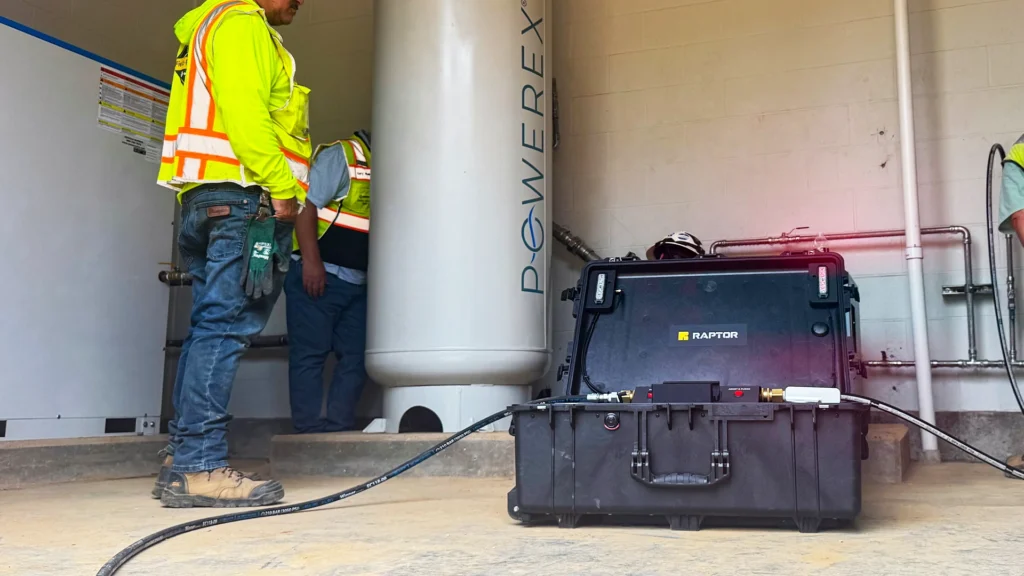
RAPTOR Device Advances to Model 2.5, Completing First Field Test
Learn the latest developments from one of the first Big Pitch winners. Discover how Dysruptek is helping advance safer pressure testing.
Castano Group’s Big Pitch Production Brings Home an Addy Award
Learn how this frequent Haskell collaborator creates award-winning projects and watch the Big Pitch video that earned.
How Scaling Preconstruction Training Serves a Growing Workforce
Haskell’s preconstruction training program strengthens estimating fundamentals and knowledge transfer. See how it improves consistency and reduces risk across markets.
How Will AI Change the Fields of Engineering and Design?
Learn how Haskell’s four-pillar AI strategy strengthens governance, accelerates delivery and empowers engineers and teams enterprise-wide.