

Brand Identity
Haskell’s brand identity carries significant equity. The current mark is an evolution of the logo that took shape in the 1970s.
Family of Brands
To further elevate the brand, the logo should represent one brand, one company and one Haskell. This is especially critical as Haskell continues to grow through geographic expansion, corporate acquisition and new areas of expertise.
The Haskell brand identity must be produced from master digital artwork. No independent typographic variations are permissible.





Logo
Primary Logotype
The Haskell logo is the face of our brand. The diamond mark and our strong wordmark are our most recognizable brand assets. Its bold sans serif font is proud and strong while at the same time clean and unpretentious. Although the logo has treatments in black and white, the ‘Haskell blue’ is the primary treatment. The Haskell logo is horizontal and is two-color — black and PMS 2945. This version is to be used for all applications whenever possible

Minimum Clear Space
A field of clear space must always surround the Haskell logo to isolate it from competing graphic elements and ensure its visibility and impact. The capital “H” can be used as a guide.
AEC Tagline
The AEC tagline should appear on all marketing materials. This includes all advertising, posters, digital and print banners, newsletters, promotional flyers and brochures. Exceptions to this requirement are informational materials such as signage, product guides, stationery, business cards and instances like the Haskell website, where Haskell is unmistakenly represented as an AEC-centric organization.
Minimum Width
The minimum width for the Haskell logo is 0.75” (print) or 225 pixels (digital).

Variations
Accepted Logo Variations
Stacked variations of the Haskell logo (with and without the AEC tagline) are acceptable when they provide a better fit within the available space.
The Diamond-H mark may also be used isolated.




Color Usage

Correct Logo Colors
When used in positive form, the logo must appear as shown in PMS 2945 and Black. The diamond-shaped bullets separating the three elements of the AEC Tagline are Cool Gray 9. All logo elements must appear in white when reversed over a dark color. The logo may also be printed in solid black.
Color
The Haskell logo should be placed on a solid background when possible. If used on a photo or textured background, the logo must be positioned against an area that offers sufficient contrast to ensure the logo’s legibility. The Diamond-H mark may also be used isolated as long as an unaltered standard logo appears in/on the same message, item or material.






Black & White
Use an all-white version of the Haskell logo on dark backgrounds. When color cannot be used, simplify the mark by using all black.
The logo’s colors are not meant to be altered in any way. All Haskell markets/divisions, product lines and corporate offices use the Haskell name and logo only.
Color Palette
Haskell Blue & Primary Accent Colors
PMS 2945 (DO NOT TINT)
CYMK 100 | 45 | 0 | 14
RGB 0 | 105 | 170
HEX #0069AA
PMS 540 (DO NOT TINT)
CYMK 100 | 55 | 0 | 55
RGB 0 | 51 | 89
HEX #003359
PMS 2995
CYMK 90 | 11 | 0 | 0
RGB 0 | 169 | 224
HEX #00A9E0
50%
25%
Grays
Tones of gray can add a sophisticated ambiance to layouts, especially where the use of additional palette colors is unnecessary or superfluous. In addition to the basic Haskell Cool Gray selections, tints of black are also acceptable. Warm grays should be avoided.
COOL GRAY 4
CYMK 24 | 17 | 15 | 0
RGB 187 | 189 | 183
HEX #BBBDB7
50%
25%
COOL GRAY 11
CYMK 63 | 52 | 44 | 33
RGB 86 | 95 | 95
HEX #565F5F
50%
25%
COOL GRAY 8
CYMK 44 | 34 | 29 | 10
RGB 136 | 138 | 139
HEX #888A8B
50%
25%
Typography
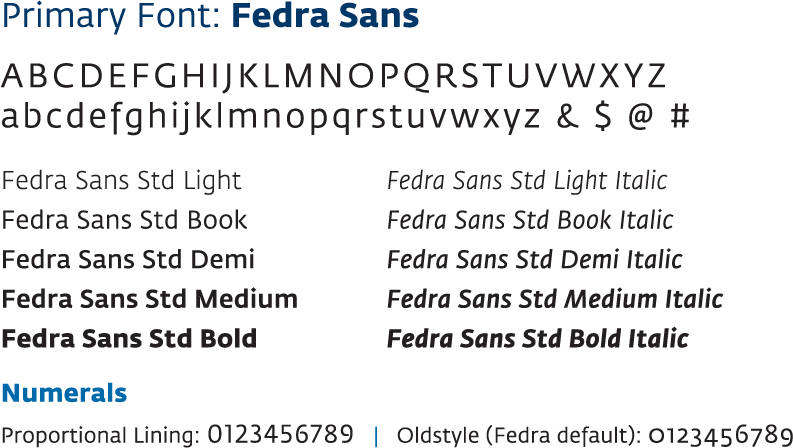
Consistent typography is important for maintaining a distinctive voice for the Haskell brand.
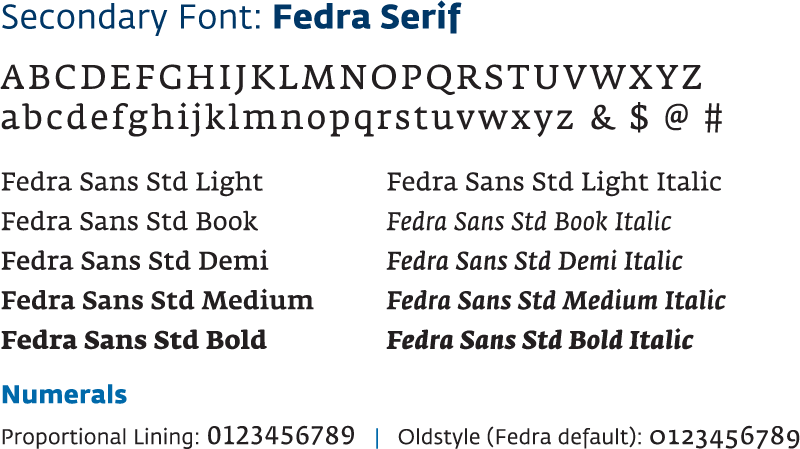
The Fedra font family is Haskell’s corporate typeface. Fedra Sans is the primary type family for both headlines and body copy. Fedra Serif may be used in an accent role as a companion to or replacement for Fedra Sans.