

Commissioning Agents Playing a Growing Role in Project Success

Nominal investment in commissioning services pays huge dividends in a project's speed to market, sustainability, productivity and profitability.
Editor’s note: Haskell.com is celebrating Engineers Week 2023 by leveraging the expertise of our nearly 200 engineers daily to address this year’s theme, “Creating the Future,” which recognizes how engineers play a vital role in innovating solutions to global challenges facing future generations. Today, we examine the expanding and highly beneficial role of mechanical, electrical, plumbing (MEP) commissioning agents.
Whether it’s installing a new mechanical, electrical and plumbing (MEP) system or retrofitting existing equipment, commissioning agents are increasingly recognized for their pivotal role in ensuring efficiency, expediency, optimization and energy reduction.
Commissioning agents are the mortar between the bricks of design, construction and equipment installation, working throughout the project lifecycle to make certain the finished product meets the project owner’s requirements and the design intent.
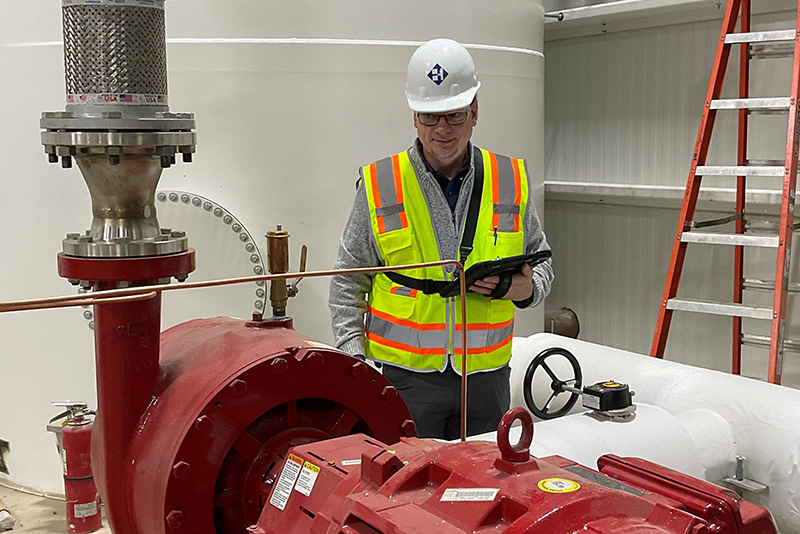
A large and growing percentage of projects place a premium on sustainability, energy savings and carbon neutrality. All green building certification programs have a commissioning requirement, recognizing the value as it relates to assurance of sustainable design. LEED, for instance, requires that the commissioning agent be involved from the beginning.
“You start with the vision of energy sustainability with the client. The engineers design that, but it’s all for naught if it’s not executed properly,” said Matt Ford, Chief Mechanical Engineer at Haskell. “The assurance of sustainability comes with commissioning. That’s when it is determined if you are meeting those targets because it’s been tested, verified and documented in real-world conditions. Commissioning gives assurance to the client and the team that we are meeting energy goals and making a sustainable impact.”
Like the sustainability organizations, states are increasingly requiring the involvement of commissioning, California and Florida among them.
“The value of commissioning and not only sustainability but the assurance of meeting codes and performing correctly, is all wrapped into the validation of the requirements,” Ford said. “Within the industry, just by the code adoption, we can see the trend.”
The common phrase “startup and commissioning” might suggest that the latter occurs at the end of a project. But commissioning agents are most effective when they’re involved from the start. Because they function outside the design and construction fields, they provide quality control not only in the MEP systems, but also between architects, construction personnel and other engineering disciplines such as structural, process and packaging.
“If we can get in from the beginning and sit through the owner’s meetings, we can understand their intent,” Haskell Commissioning Agent Bill Scholz said. “We’re like a third party that makes sure everybody plays in the sandbox together. Also, we’re able to give the client an unbiased opinion because we’re not the designer or the installer. We are the owner’s eyes and ears on systems installation.”
In addition to sustainability, commissioning agents directly affect profitability. Ensuring that design translates correctly to construction documents and that construction and installation go as planned eliminates costs by preventing change orders and generates top-line performance by expediting project completion. Further, making sure all systems operate optimally and in concert maximizes efficiency.
So, while employing a commissioning team appears as a front-end expense item, guaranteeing the greatest possible speed to market of a facility operating at peak performance returns the investment many times over.
“Value is definitely part of it,” Haskell Commissioning Agent Matthew Ellison said. “You might spend a little bit of money on the front end, but it will definitely save money on the back end when you don’t have to spend months and months working through problems.”
Ford added, “As commissioning agents, we affect project profitability. We affect the success and the certainty for our clients.”
Our Commissioning team is one of many ways Haskell ensures certainty of outcome on capital projects large and small. Contact us to discuss your facilities needs.
Related News & Insights

How ECOncrete is Building a Sustainable Future for Coastal Infrastructure
Learn how a new round of funding is pushing marine construction technology worldwide. Discover sustainable solutions for building materials.

With Contribution from Haskell, Last Energy Completes its Series C
Learn what is next for this young company that is on the forefront of new nuclear deployment and pushing toward a clean-energy future.
Bobbie Wood Earns 2025 Engdahl Award for Leadership in Design
Discover how Wood’s disciplined approach, cross-disciplinary view and commitment to integrated design elevate outcomes for Haskell’s clients.

Big Pitch 2025: Highlighting AI and Sustainability in Construction
Explore how collaboration and creativity drive innovation at Haskell. Learn how AI is enhancing sustainability tracking to improve project performance.