
Using Emulation to Maximize ROI

Learn how emulation enables manufacturers to visualize and optimize line control logic in a virtual environment, maximizing return on investment.
The ability to guide clients with data-driven decisions that maximize their return on investment is critical in any manufacturing environment. Would you like to see your system long before start-up? Is it beneficial to identify line control inefficiencies in your process? If so, emulation may be the answer.
What is emulation?
Emulation is a tool used to optimize line control logic in a virtual environment. In an emulation, the PLC is connected to a 3D-virtual model of the system and executes logic in real-time. When, for example, a photo eye becomes blocked in the virtual model, a signal is sent to the PLC. Then, the associated logic tied to that event is communicated back to the virtual model (e.g. stop conveyor), and the virtual model executes the associated command.
This exercise is beneficial in both new and existing systems. For existing systems, this could help identify and target line control inefficiencies.
Testing & Training Through Virtual Reality (VR)
Virtual Reality (or “VR”) enables a user to become totally immersed within a virtual environment. Haskell has the capability to connect this feature to an emulation which allows the client to see and interact with a system long before start-up. Interactive capabilities, like pushing buttons, interacting with the HMI, lifting boxes, etc., are available to the user and are a great way to train operators and get feedback while there’s still time to make changes to the system layout or function. Alternatively, it is possible to view the emulation model on a projector or monitor, allowing larger group training.
Driving Value with Vertical Start-Up
The value of an emulation is realized in several areas:
Test scenarios offline
Ensures optimal performance and equipment response.
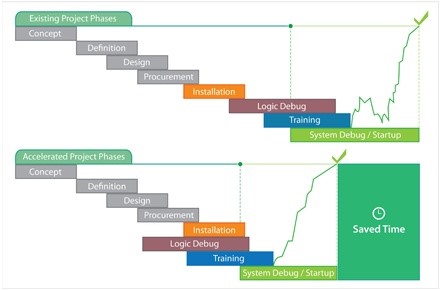
Acceleration from install to sellable product
Reduced time for engineers and service techs on-site, rapid start-up curve means sellable product quicker.
Less scrap lost to controls testing & debug
Debug ahead of start-up means less waste of sellable product when the install is ready.
Trained operators on Day 1
With a virtual replica of the line, the operators can be trained to react correctly to any given situation.
Related News & Insights

What Manufacturers Should Know About High-Temperature Heat Pumps
Discover how industrial manufacturers evaluate high-temperature heat pumps as part of an integrated thermal strategy. Learn what early design decisions shape performance and economics.

An Adventure in Nantucket, Restoring Distillery Automation
Learn how Haskell Subject Matter Expert Alan Green brought custom solutions to Triple Eight Distillery to upgrade an overmodified system.
How AI and Digital Twins Are Shaping Industrial Analytics
Discover how stronger data foundations and planning tools are improving operations. Explore insights on capacity planning, supply chains and modeling.
Data-Based Analysis Drives Optimal Manufacturing Facility Design
Learn how Haskell’s System Analytics team replaces assumptions with facts for smarter capital investment, better performance and reduced risk.