

Material Handling Solutions Ensure Safe, Efficient Warehouse Logistics

System integrators apply their expertise and insight to design operations that minimize touches in storing and moving raw materials and finished products.
Moving and accessing goods in a manufacturing facility requires ease of access, minimal touches and safety to operate smoothly. Haskell’s Material Handling and Distribution System design team conducts each segment to produce the greatest possible harmony.
Every manufacturer must store its raw materials and finished goods. The amount of storage space needed varies, but the need to store and move goods is a constant of every facility.
A large distribution center may require an automatic storage and retrieval system that delivers pallets with the push of a button. Others use standard racking, which stores pallets on metal shelves accessed by an operator using a forklift.
Haskell designs systems to move materials from truck to storage and from storage to and from the manufacturing line with efficiency and ease. Placing items near their point of use optimizes material flow and reduces travel time.
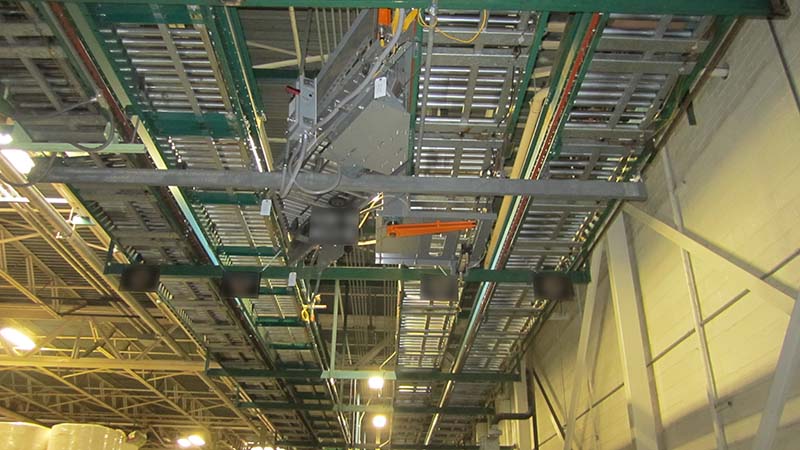
Insights Beyond the Data
Haskell engineers, also called integrators, work with operators to understand how they interact with their systems, so equipment and pathway placement provide the best possible experience.
“They are the experts in their business,” said Bela Jacobson, Haskell Vice President of Packaging Operations. “They have insights for how it works beyond data.”
Haskell also optimizes material handling by reducing touches.
“The more you touch things, the less efficient it becomes,” Jacobson said. “Every touch is time. It is a risk of damaging the product, and it is a risk in safety.”
Automation reduces touches, as does optimal space utilization. The challenge is to balance storing as much as possible in a warehouse while also offering operators easy access.
In many warehouses, pedestrians and fork trucks share the same space. Haskell’s warehouse design minimizes the likelihood of interface between pedestrians and fork trucks, which improves the safety of warehouse personnel. Integrators validate their assumptions using simulation software.
“The fewer times they intersect, the fewer times they have for an accident,” Jacobson said.
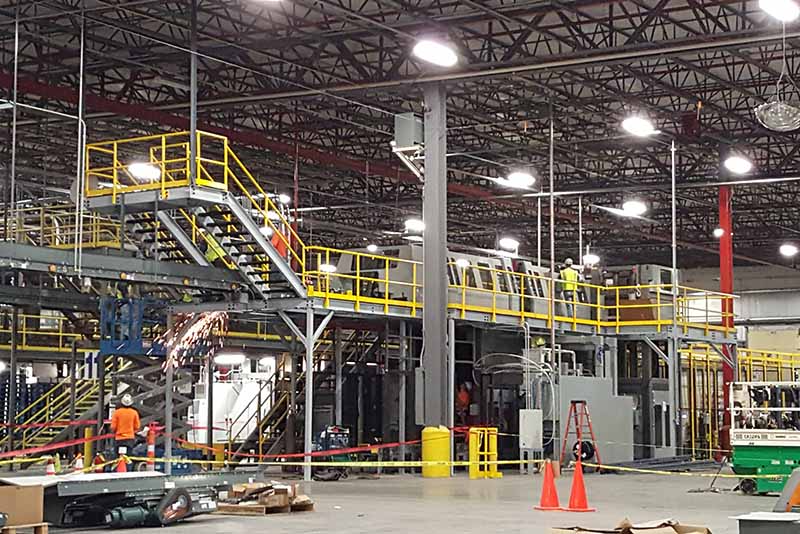
The Big-Picture View
Design simulation for proof of concept helps Haskell improve existing warehouses or design new ones. Often, clients come to Haskell when they add a new product stock-keeping units (SKUs) and need help finding space to store raw materials and finished goods.
“You either figure out how to make it work, or build a new space,” she said. “And our customers often want us to figure out how to make it work to optimize their capital budget.”
Haskell also performs capacity analysis and master planning to ensure that clients have available space for growth.
“We don’t want them to corner themselves into a solution that works today, but in one year it’s going to be outdated,” she said.
This holistic view is Haskell’s competitive differentiator.
As a design-build firm, Haskell doesn’t just design the warehouse layout. Its teams take facilities from the concept to commissioning, offering the cost savings and certainty of outcome that only come through integrated delivery.
“Understanding the whole process and not just a small part of the process helps drive a better design,” Jacobson said. “From the process side to the packaging side, we address all the different areas, so we understand how they work together. We design for the whole system, not just with blinders on for the warehouse.”
Related News & Insights
What Manufacturers Should Know About High-Temperature Heat Pumps
Discover how industrial manufacturers evaluate high-temperature heat pumps as part of an integrated thermal strategy. Learn what early design decisions shape performance and economics.
An Adventure in Nantucket, Restoring Distillery Automation
Learn how Haskell Subject Matter Expert Alan Green brought custom solutions to Triple Eight Distillery to upgrade an overmodified system.

How AI and Digital Twins Are Shaping Industrial Analytics
Discover how stronger data foundations and planning tools are improving operations. Explore insights on capacity planning, supply chains and modeling.
Data-Based Analysis Drives Optimal Manufacturing Facility Design
Learn how Haskell’s System Analytics team replaces assumptions with facts for smarter capital investment, better performance and reduced risk.